
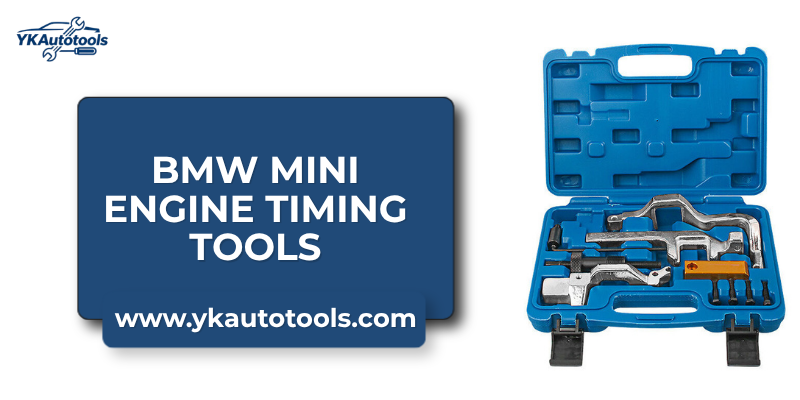
Engine timing works invisibly when everything is right. When it isn’t, the problems don’t always announce themselves immediately – they show up gradually, in fuel consumption figures that don’t add up, performance that feels slightly off, or a fault code that keeps returning. For BMW MINI engines specifically, the margin for error during timing service is tight. BMW MINI timing tools take that margin off the table – they lock the engine at the exact position the job requires so the technician isn’t relying on judgment where precision is the only acceptable standard.
Here’s what these tools do and why the right set matters on every timing job.
Understanding Engine Timing Service on MINI Engines
Timing service on a MINI engine isn’t just a chain or belt swap. Several things have to happen in the right order before any component comes off:
- The camshafts and crankshaft get locked at their specified positions before anything is disturbed
- The tensioner and guides come out and go back in without that position shifting
- Alignment gets confirmed before the engine is buttoned up and started
The N12 and N14 engines in first and second-generation MINI Coopers came out of a joint development programme between BMW and PSA. The same engine family sits in the Peugeot 207 and several Citroen models, so tooling compatibility runs across those platforms too. The N14 – the turbocharged version in the Cooper S – runs under higher stress than the naturally aspirated N12, which makes chain condition and service accuracy more critical, not less.
The Locking Components Inside a Timing Tool Kit
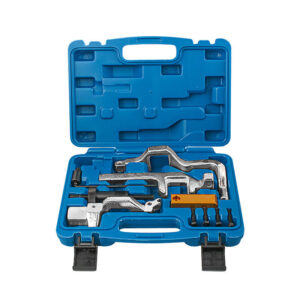
A timing chain tool kit for BMW MINI engines is made up of several pieces that each do a specific job:
- A camshaft locking tool that holds both the inlet and exhaust camshafts at TDC
- A crankshaft locking pin that stops the crank from turning once it’s set
- A tensioner retaining tool that keeps the chain tensioner compressed during removal, so the chain doesn’t jump
None of these are interchangeable with general-purpose alternatives. The locking points on N12 and N14 engines are cut to specific dimensions – a tool that interfaces with them has to match those dimensions exactly. One that’s slightly out either won’t seat at all or seats at a position that looks right but isn’t. That second scenario is the more dangerous one. The engine gets reassembled, it starts, and whatever is wrong only becomes clear once it’s running. The mini N14 timing tool set is built around the geometry of that engine’s camshaft end plates and the access restrictions inside a MINI engine bay, which is compact enough that clearance is a real consideration in how these tools are designed.
The Risks of Using Generic Tools on MINI Engines
Generic tooling on MINI timing jobs creates problems in two ways. The first is fitment. A tool that doesn’t contact the locking surface properly gives the technician a false read – the engine appears locked when it isn’t sitting at exactly the right position. The second is access. A tool designed for a different engine won’t necessarily clear the components around it in a MINI bay, which forces angles that compromise accuracy.
A BMW MINI timing tool kit built for the N12 and N14 removes both issues. The profiles match the locking geometry on these engines, the dimensions allow for the clearances inside the bay, and the engine ends up held where it needs to be. There’s no substituting experience or careful work for that – the tool either fits the application or it doesn’t.
Diesel MINI Variants and the W16D Engine
Not every MINI runs a petrol engine. The W16D diesel, fitted to the MINI Cooper D, has different timing requirements and needs its own tool set. Diesel engines run higher compression than petrols and the consequences of getting timing wrong are worse – pistons and valves occupy the same space at different points in the cycle, and an engine assembled even slightly out of time can cause contact damage that destroys components.
The W16D kit covers the same categories – camshaft locking, crank positioning, tensioner retention – but the individual tools aren’t the same as the N12/N14 set. Assuming they cross over is a mistake that costs considerably more to sort out than the correct tooling would have.
Material Quality and Dimensional Accuracy in Timing Tools
Good BMW MINI timing repair tools don’t flex under load and don’t wear out of tolerance after regular use. Locking pins and plates are hardened steel. Larger components where weight matters sometimes use aluminium alloy, provided strength isn’t compromised. Neither material choice matters much if the machining isn’t accurate – dimensional precision is what separates a tool that does the job from one that only looks like it does.
A locking plate that’s half a millimetre out of spec will pass a visual check. It won’t pass an engine that’s been reassembled at the wrong position. That’s the standard every piece in a timing kit needs to meet, and it’s what separates quality manufacturing from a cheaper alternative that looks identical in a product photo.
YK Autotools supplies BMW MINI timing tool kits for N12, N14, and W16D engines – dimensionally accurate, material-verified, and built for workshops that don’t have room for comebacks.