
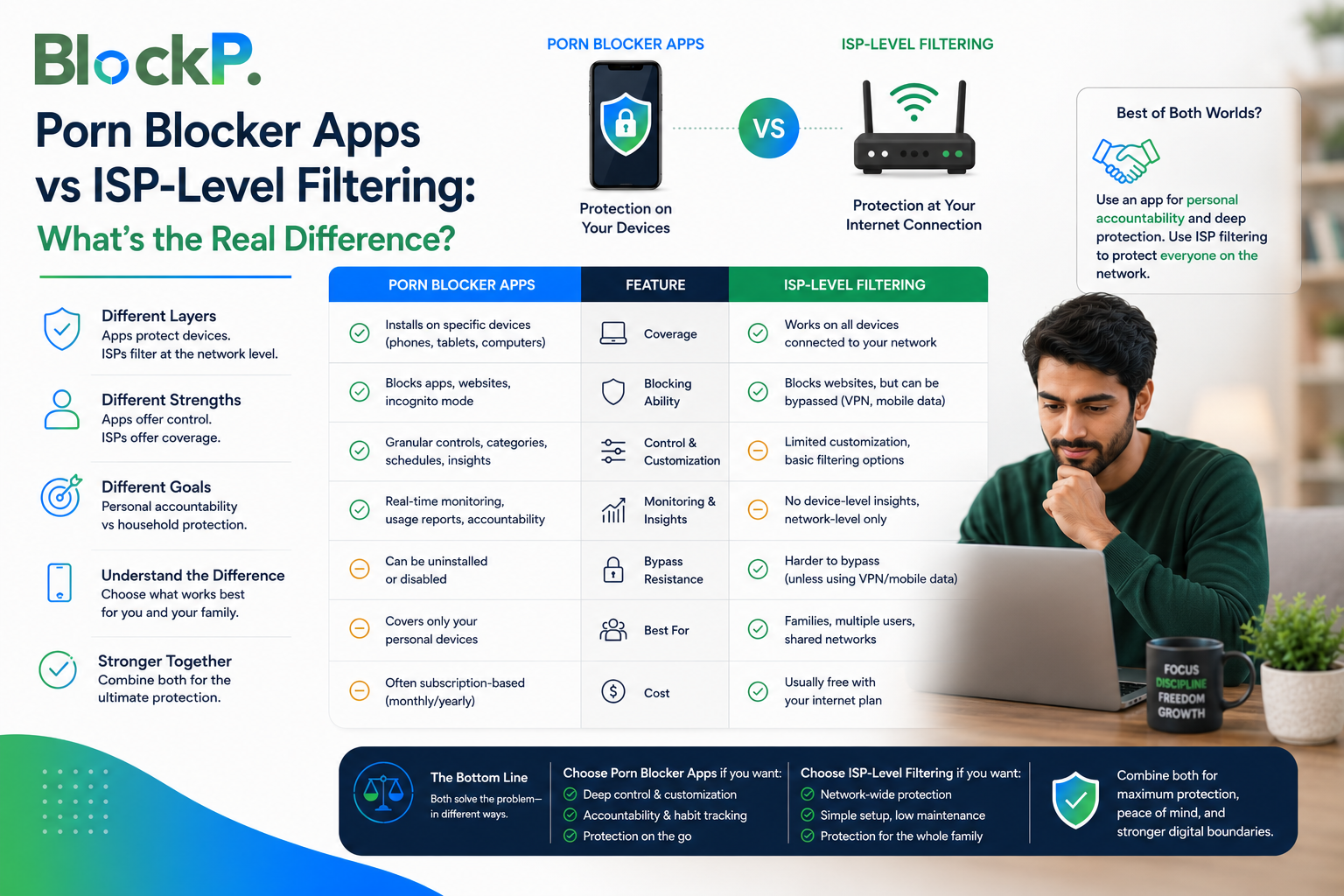
As governments, regulators, internet providers, and families continue searching for ways to create safer online environments, two approaches frequently appear in discussions about content filtering: personal porn blocker apps and ISP-level filtering.
At first glance, both seem to accomplish a similar goal—limiting access to adult content. However, they operate in fundamentally different ways and raise different questions about privacy, control, effectiveness, and digital rights.
In recent years, several countries have explored or implemented various forms of network-level filtering, age-verification systems, and internet safety measures. At the same time, millions of users have voluntarily adopted personal content blockers as part of broader digital wellness, productivity, parental control, or online safety strategies.
Understanding the difference between these approaches is important because they affect users in very different ways.
While one emphasizes centralized control at the network level, the other focuses on individual choice and personalized filtering.
What Is ISP-Level Filtering?
ISP stands for Internet Service Provider.
An ISP is the company that delivers internet access to homes, businesses, and mobile devices.
Examples include broadband providers, fiber internet companies, and mobile network operators.
ISP-level filtering occurs when content restrictions are applied directly through the internet provider’s network.
Instead of filtering content on a user’s device, the filtering happens before websites reach the device.
This means that requests to certain websites may be blocked or restricted at the network level.
In some countries, ISP filtering has been discussed or implemented for purposes such as:
- Child safety
- Illegal content removal
- Malware protection
- Copyright enforcement
- Age-restricted content controls
Because filtering occurs at the network level, it can affect all devices connected through that internet service.
What Are Porn Blocker Apps?
Porn blocker apps take a different approach.
Rather than filtering traffic through the internet provider, these tools operate directly on individual devices.
Depending on the solution, they may monitor:
- Websites
- Search results
- Applications
- Images
- Videos
- Keywords
- Browser activity
Many modern blockers use a combination of:
- URL filtering
- AI-powered content detection
- Custom blocklists
- Whitelists
- Accountability tools
- Focus and productivity features
The key distinction is that users typically choose to install these tools themselves.
Filtering occurs according to the preferences established by the user or family.
The Core Difference: Network vs Device
The simplest way to understand the distinction is location.
ISP filtering works at the internet network level.
Porn blocker apps work at the device level.
This difference has practical implications.
ISP Filtering
- Applies to all connected devices
- Managed by the provider
- Generally offers fewer customization options
- May affect entire households
App-Based Filtering
- Installed individually
- Managed by users
- Often highly customizable
- Can vary across devices
The choice between these approaches depends largely on individual needs and priorities.
Flexibility and Customization
One area where app-based blockers typically stand out is flexibility.
Every user has different goals.
Some want to block only adult content.
Others want to reduce distractions from social media, gambling websites, or specific apps.
Many modern blocker apps allow users to:
- Create custom blocklists
- Add keywords
- Whitelist approved websites
- Schedule filtering times
- Configure different protection levels
ISP filtering systems are often broader and less personalized.
Because they operate across large networks, customization options may be more limited.
Family Use Cases
Families often represent a major audience for both filtering approaches.
Parents may seek ways to reduce accidental exposure to inappropriate material while supporting healthy internet habits.
ISP filtering offers a household-wide solution.
Once enabled, protection may automatically apply to all connected devices.
However, family members often have different needs.
A teenager may require different access permissions than a younger child.
App-based solutions frequently provide more granular control over individual devices and user profiles.
This flexibility can be valuable for households with multiple users.
Productivity and Digital Wellness
Another important distinction is purpose.
ISP filtering is typically designed around access control.
Porn blocker apps increasingly serve broader functions.
Many users install blockers for:
- Productivity
- Focus enhancement
- Digital wellness
- Habit management
- Intentional technology use
Students may block distracting websites during study sessions.
Professionals may reduce access to time-consuming content during work hours.
Digital minimalists may use filters to create more intentional online environments.
This broader use case helps explain why app-based blockers continue gaining popularity.
Privacy Considerations
Privacy is often one of the most discussed aspects of content filtering.
With ISP-level systems, users may wonder:
- What data is being processed?
- How are filtering decisions made?
- What information is retained?
- Who controls the filtering infrastructure?
The answers vary depending on the country, provider, and regulatory framework.
App-based blockers raise their own privacy questions, but users generally have more visibility into the specific tool they choose and the settings they enable.
Transparency, privacy policies, and user control remain important considerations regardless of which filtering approach is used.
Effectiveness Against Modern Content
The internet changes rapidly.
New websites appear constantly.
Content frequently moves across platforms.
This creates challenges for all filtering systems.
Traditional filtering methods often relied heavily on static blocklists.
Modern app-based solutions increasingly use AI-powered detection and real-time analysis to identify content dynamically.
For example, platforms such as BlockP reflect the growing trend toward user-controlled filtering systems that combine content detection, customization, and digital wellness features to help individuals manage their online experiences according to personal goals.
As filtering technologies evolve, both ISP-level systems and device-based tools continue adapting to new challenges.
Human Rights, Choice, and Censorship Concerns
Discussions about filtering often extend beyond technology into broader questions about digital rights.
Most people agree that protecting children from inappropriate content is an important objective.
However, debates sometimes arise regarding how these protections should be implemented.
Critics of broad network-level filtering occasionally express concerns about:
- Overblocking legitimate content
- Lack of transparency
- Reduced user choice
- Potential censorship risks
Supporters argue that network-level protections can improve safety and simplify implementation.
From a human-rights perspective, many experts advocate balancing online safety with freedom of expression, privacy, and individual autonomy.
This is one reason personal-choice-based filtering remains attractive to many users.
Individuals can voluntarily establish boundaries that reflect their own values and goals without requiring blanket restrictions across entire networks.
Which Approach Is Better?
There is no universal answer.
The best solution depends on the situation.
ISP filtering may be attractive for:
- Household-wide protection
- Simplicity
- Centralized management
App-based blockers may be preferable for:
- Personal control
- Customization
- Productivity goals
- Cross-device flexibility
- Digital wellness objectives
In some cases, users may even combine multiple approaches for additional protection.
The important factor is understanding what each method is designed to accomplish.
Conclusion
Although porn blocker apps and ISP-level filtering are often discussed together, they represent fundamentally different approaches to online content management.
ISP filtering operates at the network level and is typically managed by internet providers or regulatory frameworks. Porn blocker apps operate at the device level and are generally chosen voluntarily by individual users or families.
As conversations around child safety, digital wellness, privacy, and internet governance continue evolving, both approaches will likely remain part of the broader online safety ecosystem.
For many users, the key difference comes down to control. ISP filtering emphasizes centralized protection, while app-based solutions emphasize personal choice and customization. Understanding that distinction helps individuals make informed decisions about how they want to manage their online environments.
Frequently Asked Questions
Can ISPs block porn at the network level?
Yes. Internet service providers can implement filtering systems that restrict access to certain categories of websites, including adult content. The availability and scope of these systems vary depending on local laws, regulations, and provider policies.
Why might individuals prefer app-based control over ISP filtering?
Many users prefer app-based solutions because they offer greater customization, flexibility, transparency, and personal control. Users can often choose exactly what to block, when filtering applies, and how strict the settings should be.
Does network-level filtering raise censorship concerns?
Some digital rights advocates argue that broad network-level filtering can raise concerns about transparency, overblocking, and potential restrictions on lawful content. Others view such measures as important tools for online safety. The debate often centers on finding an appropriate balance between protection and individual freedoms.