
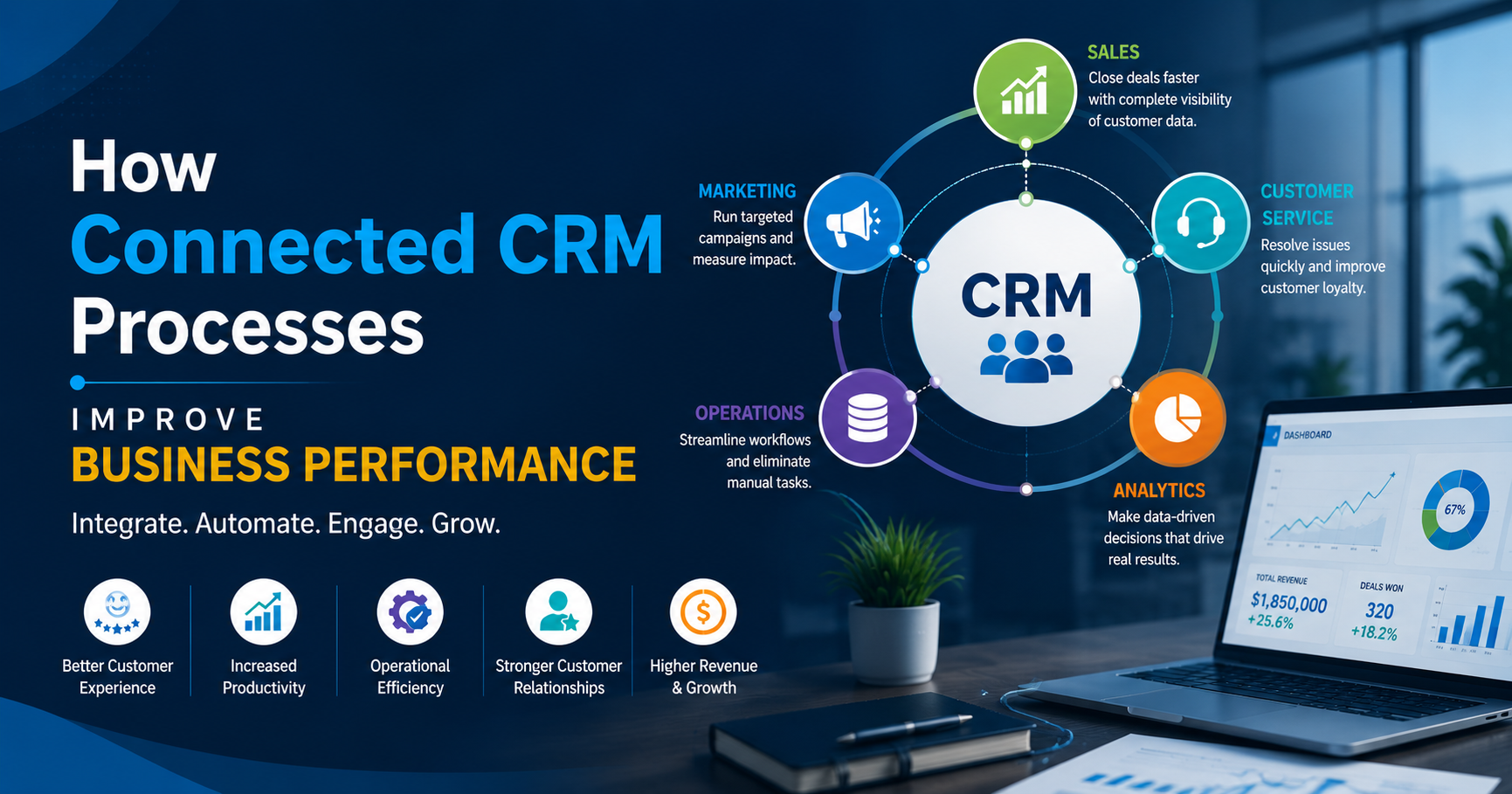
Proper CRM integration improves team productivity by 26%, according to Forrester Research, and Nucleus Research found that revenue per salesperson climbs 41% once mobile access and real-time data enter the picture. Salesforce’s own data points in the same direction, showing a 29% average increase in sales revenue following CRM adoption. The pattern across every one of these studies is consistent: the value doesn’t come from owning a CRM license. It comes from connecting that CRM to every other system a business runs on.
Most companies already have a CRM. Far fewer have a connected one. Customer data lives in Salesforce, but the marketing team works out of a separate email platform, finance runs invoicing through a disconnected ERP, and support tickets sit in a third tool nobody else can see. Connected CRM processes close those gaps, and the businesses that get this right are the ones pulling ahead on sales cycle length, customer retention, and decision speed. This article looks at what a connected CRM actually requires and why the right Salesforce development company is often the difference between a functioning CRM and one that actually moves the business forward.
Understanding Connected CRM Processes
A connected CRM process means customer data, sales activity, support history, and marketing engagement all flow through one coherent system, instead of sitting in disconnected silos that require manual reconciliation. It’s the difference between a sales rep manually copying a lead’s details from a marketing tool into Salesforce, and that same lead automatically appearing in Salesforce, scored and routed, the moment they fill out a form.
Connection happens at three levels: data (a single source of truth for customer records), process (workflows that trigger actions across systems automatically), and visibility (dashboards and reports that pull from every connected system, not just one). A CRM without these three layers still functions as a database. A connected CRM functions as an operating system for the business.
Why Businesses Need an Integrated CRM Ecosystem
CRM failure rates remain stubbornly high, with estimates ranging from 20% to 70%, and poor integration with other business tools ranks among the leading causes, according to industry research compiled by SLT Creative. That failure pattern shows up long before anyone calls the project a failure outright. It shows up as sales reps re-entering the same customer data three times a day, as marketing running campaigns against a lead list that’s three weeks out of date, and as support agents with no visibility into what sales promised the customer last quarter.
An integrated ecosystem removes these friction points by design. When Salesforce talks to the ERP, the marketing automation platform, and the support desk in real time, every department works from the same version of the truth. That alignment is what separates a CRM that gets used from one that gets quietly worked around.
How Connected CRM Processes Improve Business Performance
Unified Customer Data
When every touchpoint, from a marketing email open to a support ticket, feeds into one customer record, sales and service teams stop working with partial information. A rep can see the full relationship history before a call instead of piecing it together from memory or a spreadsheet.
Faster Sales Cycles
Automated lead routing, real-time data syncing, and fewer manual handoffs cut the friction that slows deals down. Multiple 2026 CRM studies report sales cycle reductions in the 8% to 14% range once integration removes the manual steps between stages.
Better Team Collaboration
Sales, marketing, and support stop operating as separate silos once they share a connected data layer. A support agent can see what a prospect was promised during the sales process. A marketer can see which leads a sales rep is actively working and avoid sending a conflicting campaign.
Improved Customer Experience
Customers notice when a company already knows their order history, their open support ticket, and their last conversation with a rep. That continuity, only possible with connected systems, is a major driver of the 86% higher likelihood of exceeding sales goals that CRM-enabled teams report, according to Freshworks research cited in recent CRM benchmarking studies.
Data-Driven Decision Making
Leadership teams working from unified dashboards can trust the numbers they’re looking at, because those numbers reflect every connected system rather than one department’s partial view. That trust is what turns a CRM from a reporting tool into an actual decision-making engine.
The Role of Salesforce in Building a Connected Business
Salesforce has held the top position in the global CRM market for twelve consecutive years, according to IDC, commanding roughly 21% market share, more than the combined total of several of its closest competitors. That dominance isn’t just about brand recognition. Salesforce’s architecture, built around a shared data model and an extensive integration layer through MuleSoft, gives businesses a foundation that’s genuinely built for connection rather than isolation.
The platform’s Integration and Analytics segment, which combines MuleSoft and Tableau, generated $5.78 billion in fiscal 2025, reflecting just how central integration has become to how enterprises actually use Salesforce. Rather than treating Salesforce as a standalone sales tool, businesses building connected operations use it as the central hub that ERP systems, marketing platforms, communication tools, and custom applications all plug into.
Key CRM Integrations That Deliver Greater Business Value
- ERP integration — Connects sales data with inventory, finance, and order fulfillment, closing the gap between what sales promises and what operations can deliver.
- Marketing automation integration — Syncs lead data and campaign engagement in real time, so sales always works the most current, best-scored leads.
- Communication platform integration — Tools like Slack, connected to Salesforce for over 64% of companies running both platforms, bring deal collaboration and customer queries directly into the channels teams already use.
- Customer service platform integration — Gives support agents full visibility into the sales and billing history behind every ticket.
- Data and analytics platform integration — Tools like Tableau turn raw CRM data into dashboards executives actually check.
Each of these integrations solves a specific operational gap, and the businesses seeing the strongest returns are typically running several of them together rather than treating CRM integration as a single project with a single vendor connection.
Why Partnering with a Salesforce Development Company Makes a Difference
Off-the-shelf Salesforce configuration handles the basics. It rarely handles the custom workflows, legacy system connections, and industry-specific data models that separate a functioning CRM from a genuinely connected business. This is where a specialized Salesforce development company earns its fee.
An experienced development partner brings architecture expertise that determines whether integrations scale cleanly as the business grows, or turn into a tangle of point-to-point connections that break every time one system updates. They bring custom API and middleware development for connecting Salesforce to systems that don’t have a pre-built integration available. And they bring the discipline to design data governance and validation rules upfront, which is exactly what prevents the data quality problems that Gartner has flagged as the leading cause of stalled CRM and AI initiatives.
Just as important, a development partner that has done this work across multiple industries can flag the integration pitfalls before they become expensive rework. That experience is difficult to replicate with an internal team handling a first-time CRM integration project.
Common Challenges in CRM Integration and How to Address Them
- Data silos and duplicate records. Address this with a clear data governance model and deduplication rules built into the integration itself, not bolted on afterward.
- Poor user adoption. The leading cause of CRM project failure according to multiple industry studies. Address it with workflows designed around how reps actually work, not how the system happens to be configured out of the box.
- Legacy system compatibility. Older ERP or finance systems often lack modern APIs. Custom middleware, built by a development team with integration experience, solves this without forcing a costly system replacement.
- Data quality issues. Nearly a third of executives report inaccurate CRM data. Validation rules, required fields, and automated data cleansing prevent this from compounding over time.
- Underestimated scope. Integration projects that start as “just connect these two systems” often expand once teams discover how many workflows depend on accurate, real-time data. Scoping the full ecosystem upfront avoids budget overruns later.
Best Practices for Building a High-Performance Connected CRM
- Map every system that touches customer data before starting integration work, not after.
- Prioritize integrations by business impact, starting with the connections that remove the most manual work or the most costly data gaps.
- Build data governance rules into the integration architecture, rather than trying to clean up data quality after systems are already connected.
- Train teams on workflows, not just software. Adoption improves when reps understand why a process changed, not only how to click through it.
- Review integration performance quarterly. New tools get added, workflows shift, and a connected CRM needs periodic tuning to stay genuinely connected rather than gradually drifting back into silos.
Future Trends in Connected CRM and AI-Powered Automation
AI is becoming inseparable from CRM strategy, and Salesforce’s Agentforce platform illustrates how fast that shift is moving. Agentforce and Data 360 combined reached nearly $1.4 billion in annual recurring revenue by the third quarter of fiscal 2026, growing 114% year-over-year, making it the fastest-growing product line in Salesforce’s history. That growth reflects a broader shift where AI agents handle repetitive tasks like lead scoring, follow-up scheduling, and case routing, freeing sales and service teams for higher-value work.
Gartner’s research offers an important caution alongside this trend: an estimated 40% of agentic AI CRM projects are expected to fail or stall by 2028, with data quality, not the AI itself, cited as the primary cause. This reinforces a theme that runs through this entire discussion. Connected data infrastructure has to come first. AI and automation amplify whatever foundation already exists, for better or worse, which makes the integration work covered above more relevant, not less, as automation capabilities expand.
Conclusion
A CRM license alone doesn’t move a business forward. Connected processes do. The data backs this up consistently: faster sales cycles, higher productivity, stronger revenue per rep, and better customer retention all trace back to how well a company’s systems talk to each other, not to which CRM logo sits on the login screen. Salesforce provides the architecture to make that connection possible at scale, but realizing it requires deliberate integration work, careful data governance, and often the expertise of a Salesforce development company that has solved these problems before. Businesses that treat integration as a core part of their CRM strategy, not an optional add-on, are the ones turning customer data into measurable performance gains.
Frequently Asked Questions (FAQs)
- What makes a CRM “connected” versus a standard CRM setup?
A connected CRM shares data and triggers workflows across every system that touches the customer relationship — marketing, sales, support, finance — instead of functioning as an isolated sales database. - How long does a typical Salesforce integration project take?
Timelines vary by scope, but most mid-market integration projects covering two to three core systems take a few months from discovery through deployment and testing. - Why do so many CRM integration projects fail?
Poor user adoption and lack of integration with existing tools are consistently cited as the leading causes, ahead of any issues with the CRM software itself. - Do small and mid-sized businesses need a Salesforce development company, or can they configure it themselves?
Basic configuration is manageable in-house. Custom integrations involving legacy systems, complex workflows, or multiple connected platforms typically benefit from specialized development expertise to avoid rework and data quality issues later. - How does AI fit into a connected CRM strategy?
AI tools like Salesforce’s Agentforce depend on clean, well-integrated data to function reliably. Businesses that build connected CRM infrastructure first are better positioned to add AI-driven automation on top of it successfully.