
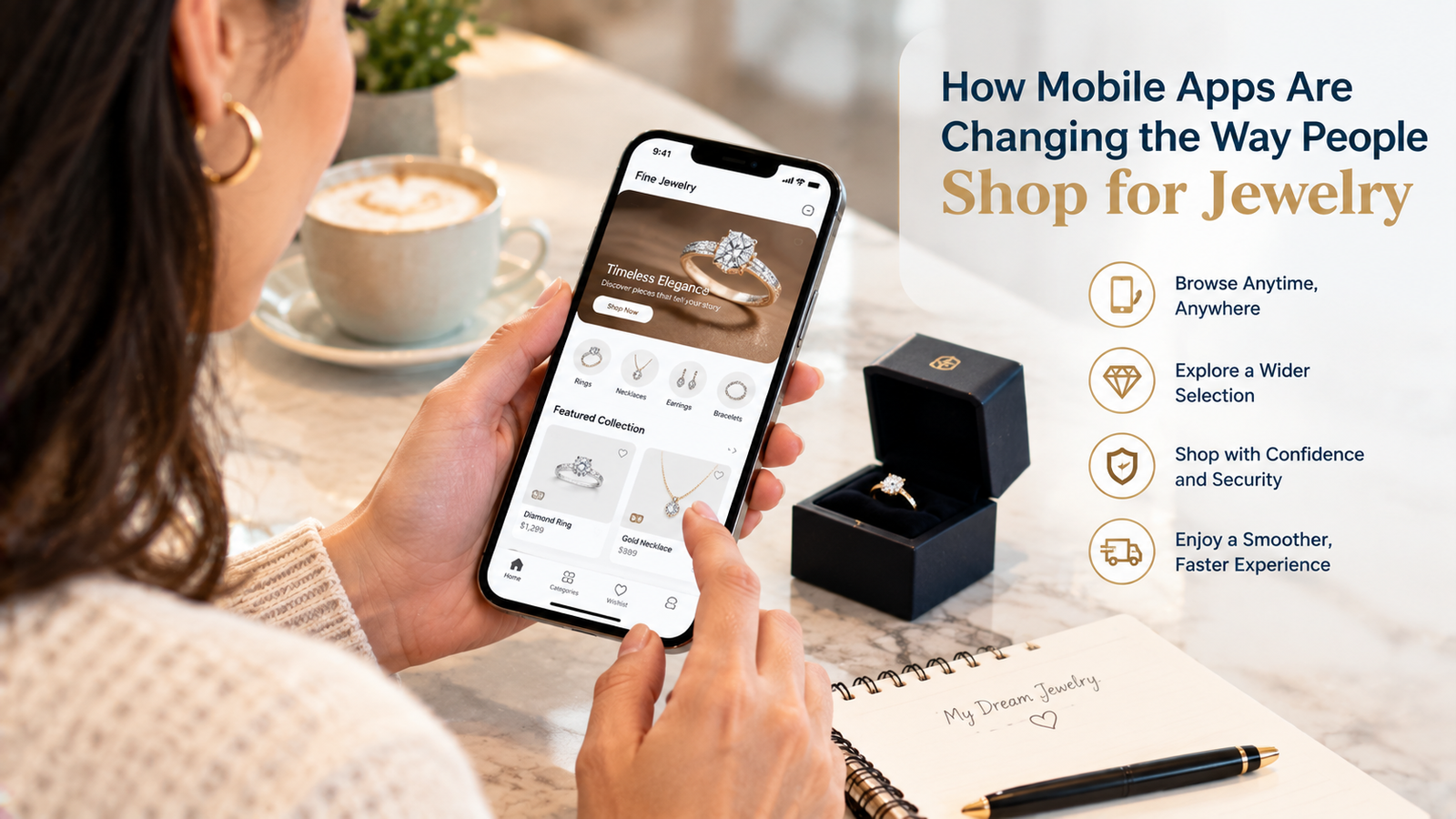
Sofia wanted to buy her mother an anniversary ring but stalled for two weeks because she couldn’t answer the one question that actually mattered: how would it look on her mother’s hand. Photos on a retailer’s website showed the ring on a model with different skin tone, different finger length, different everything. She almost drove forty minutes to the nearest store just to stand there and guess. Instead, she opened an app that let her upload a photo of her mother’s hand and see the actual ring, rendered in real time, sized correctly, sitting exactly where it would sit. She ordered it that night.
That single moment, replacing a guess with something close to certainty, is exactly what’s driving jewelry brands toward a mobile app development company instead of settling for a standard product catalog with static photos. Online jewelry sales have climbed sharply as a share of the overall market, and a meaningful part of that growth traces directly to virtual try-on technology closing the one gap that used to make jewelry uniquely hard to sell online: you can’t pick up a ring through a screen, and you definitely can’t hold a necklace up to the light to see how it catches it.
Why Jewelry Was Always the Hardest Category to Sell Online
Clothing sizes run in predictable ranges, and a return is annoying but manageable. Jewelry doesn’t work that way. A ring that photographs beautifully on a model’s hand often looks completely different on a customer’s own, shorter fingers, a different skin tone catching light differently, proportions that make a delicate design look either perfect or lost. Retailers selling fine jewelry online have historically absorbed higher return rates than almost any other e-commerce category precisely because of this uncertainty, and every one of those returns costs real money in shipping, restocking, and a customer who walks away less confident about buying from the same brand again. Static product photography was never going to solve a problem that’s fundamentally about fit and personal presentation, not just appearance.
What Virtual Try-On Actually Does
Modern jewelry try-on apps work in one of two ways, and most serious platforms now support both. A live camera mode tracks a customer’s face, hand, or wrist in real time and overlays a 3D digital model of the piece, letting a ring move naturally with a finger or a necklace follow the actual neckline as the customer turns their head. A photo upload mode works for anyone who’d rather not turn on a camera, analyzing a submitted image, identifying exactly where a ring or earring belongs, and rendering the piece onto the photo with realistic lighting and proportion. Neither approach is a cartoonish filter anymore. The technology has moved to genuinely photorealistic rendering, sophisticated enough to show the actual texture and craftsmanship of a piece rather than a flat, generic overlay that only approximates what the jewelry looks like.
The Numbers Behind Why Brands Are Investing Now
Mobile augmented reality usage has climbed past a billion active users worldwide and keeps growing, and jewelry brands have taken notice because the return on this specific technology is measurable in ways that are hard to ignore. A majority of shoppers now say they specifically prefer retailers offering virtual try-on capability over ones that don’t, and major names in the industry, from heritage jewelers to mass-market retailers, have already built the feature directly into their platforms rather than treating it as an experimental add-on. The pattern shows up consistently across the data: try-on technology increases how long a shopper stays engaged with a product page, meaningfully lowers uncertainty at the exact moment someone is deciding whether to complete a purchase, and reduces the return rate that used to eat into jewelry retailers’ margins more than almost any other line item.
Where AI Fits Beyond the Try-On Feature Itself
Virtual try-on gets most of the attention, but it’s only part of what’s changed. AI-driven personalization is increasingly built into the same shopping experience, surfacing recommendations based on a customer’s actual browsing behavior and past purchases rather than generic bestseller lists everyone sees identically. A shopper who spends time looking at minimalist gold pieces gets shown more of that aesthetic rather than being funneled toward whatever’s trending broadly that month. Some platforms have also started generating streamlined product content automatically, descriptions, styling suggestions, even short video previews, cutting down on the manual content production that used to be a real bottleneck for smaller jewelry brands trying to compete with retailers that had entire marketing departments dedicated to product photography and copy.
Why High-Value Pieces Still Need a Human at the End
It’s worth being honest about where this technology’s limits actually sit, because overselling it does jewelry brands no favors. On a five-figure piece, virtual try-on works as a confidence tool that moves a hesitant browser toward a serious decision, not as something that closes the sale by itself. A customer considering a significant purchase still wants a real conversation, someone who can answer a specific question about a stone’s certification or a custom sizing option that an app can’t fully replicate. The brands getting this right treat the app as the funnel that hands off a more informed, more confident buyer to a live consultation, whether that’s an in-app video call or an in-store appointment, rather than trying to make the entire high-value purchase happen inside the try-on feature itself.
The Journey Now Crosses Several Channels Before a Sale Closes
Jewelry buying rarely happens in one sitting anymore, and the apps built for this category increasingly reflect that. A customer often discovers a piece through a short video on social media, moves into an app to try it on virtually, books a video consultation with an actual jeweler to ask about a stone’s certification, and finishes the purchase in a physical store weeks later, or in the reverse order entirely. Building for that reality means an app can’t function as an isolated sales channel competing with a brand’s physical stores and social presence, it has to sit at the center of a journey that moves fluidly between all of them. Appointment booking built directly into the app, letting a customer schedule a video call or an in-store visit without leaving the same interface where they were browsing and trying on pieces, has become one of the more consequential features for jewelry brands specifically because it acknowledges this reality rather than pretending every sale happens in a single app session.
Sizing Accuracy Is Where a Lot of Builds Quietly Fail
Beyond the visual rendering itself, one of the harder problems in this category is getting sizing genuinely right, not just approximately right. A ring that renders beautifully but sits at the wrong scale on a customer’s actual finger undermines the entire point of the feature, turning a confidence-building tool into a source of the exact uncertainty it was meant to eliminate. The stronger platforms in this space have built dedicated sizing tools directly into the try-on experience, measuring a finger or wrist through the camera itself rather than asking a customer to guess a ring size from a printed chart, which remains one of the most common reasons jewelry gets returned even when the customer loved how it looked on screen. A brand evaluating a development partner for this kind of build should weight this capability heavily, since a visually impressive try-on feature that gets sizing wrong solves only half the problem it was built to address.
What Actually Drives the Price of Building One of These
A basic try-on feature handling a narrow category, rings on a hand, for instance, sits at the more modest end of what a build like this costs, while a full platform supporting rings, necklaces, earrings, and bracelets across live camera tracking and photo upload modes, integrated with AI-driven personalization and appointment booking, runs considerably higher. The Mobile Applicatoin Development cost for this category tends to scale most with how many product types the try-on engine has to handle accurately and how photorealistic the rendering needs to be, since a ring sitting naturally on a moving hand is a meaningfully harder rendering problem than a static overlay. Integration with an existing product catalog and inventory system adds its own layer of cost too, since the try-on experience is only as good as the 3D models and data feeding it, and building those models for an entire jewelry catalog is often a bigger line item than the app’s interface itself.
What Changed for Sofia
Sofia never drove to that store, and she didn’t need to stand in front of a mirror trying to imagine how a ring would look on someone else’s hand from memory. She saw it, rendered accurately on an actual photo of her mother’s hand, and made a confident decision in the time it used to take just to decide whether the trip was worth it. That’s the real shift running through jewelry retail right now, not a flashier shopping app for its own sake, but the specific, longstanding uncertainty that used to keep people away from buying jewelry online finally getting solved by technology built to solve exactly that problem. The trip she almost made, forty minutes each way just to stand in front of a case and guess, has quietly become the exception rather than the default for a category that spent decades assuming it had to be sold in person, one showroom visit and one guess at a time.