
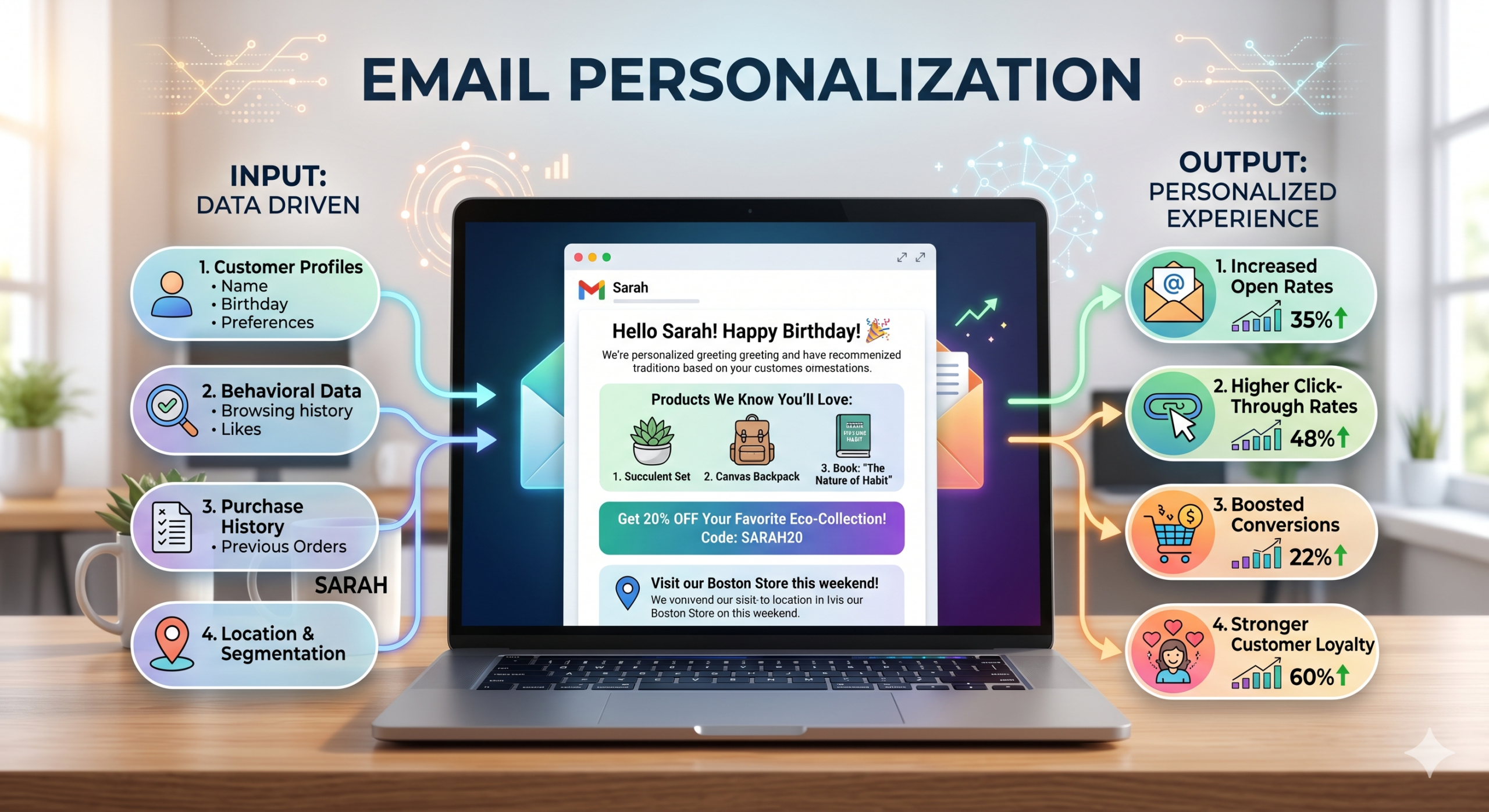
Email marketing has evolved significantly over the years, but many businesses still rely on outdated segmentation strategies that no longer meet modern customer expectations. Traditional segmentation once helped marketers organize audiences and improve campaign targeting, but consumer behavior today is far more dynamic and complex.
Customers expect brands to understand their preferences, anticipate their needs, and deliver relevant communication in real time. Static audience segments are often too broad to support this level of personalization.
This is why AI-powered email personalization is becoming a major competitive advantage. By leveraging machine learning, behavioral data, and predictive analytics, businesses can create highly individualized experiences that outperform traditional segmentation across engagement, conversions, and customer retention.
What is Traditional Email Segmentation?
Traditional segmentation involves dividing audiences into groups based on predefined characteristics.
These segments are typically created using criteria such as:
- Age
- Gender
- Location
- Purchase history
- Basic engagement metrics
Marketers then send campaigns tailored to each segment.
For example:
- Customers in a specific region receive local promotions
- Frequent buyers receive loyalty emails
- New subscribers receive welcome campaigns
While this approach is more effective than mass email marketing, it has limitations in today’s data-driven environment.
The Limitations of Traditional Segmentation
Static Audience Groups
Traditional segments are usually fixed for a period of time. However, customer behavior changes constantly.
A shopper who was interested in electronics last month may now be browsing fashion products.
Static segmentation struggles to adapt quickly.
Broad Targeting
Even within a segment, customer preferences can vary significantly.
For example:
- Two users in the same age group may have completely different interests
- Purchase behavior may differ despite similar demographics
This reduces relevance.
Manual Management
Traditional segmentation often requires marketers to create and maintain audience groups manually.
This process becomes difficult as customer data grows.
Limited Real-Time Responsiveness
Traditional segmentation does not typically react instantly to customer behavior.
As a result, campaigns may feel outdated by the time they reach the customer.
What is AI-Powered Email Personalization?
AI-powered email personalization uses artificial intelligence and machine learning to tailor email experiences at the individual level.
Instead of grouping users into static segments, AI analyzes customer behavior continuously and adapts content dynamically.
This includes:
- Personalized recommendations
- Predictive content selection
- Real-time behavioral triggers
- Send-time optimization
The goal is to create highly relevant and adaptive email experiences.
How AI-Powered Personalization Works
Behavioral Data Analysis
AI systems analyze customer interactions such as:
- Website browsing behavior
- Product views
- Purchase history
- Email engagement
This helps identify patterns and preferences.
Predictive Modeling
Machine learning predicts future customer actions, including:
- Likelihood to purchase
- Preferred products
- Churn risk
This allows businesses to engage customers proactively.
Real-Time Adaptation
Content can change dynamically based on real-time customer activity.
For example:
- Recommendations update based on recent browsing behavior
- Promotions change based on inventory availability
Continuous Learning
AI models improve over time by learning from customer interactions and campaign performance.
Why AI-Powered Personalization Performs Better
Higher Relevance
AI tailors content to individual users rather than broad groups.
This creates more meaningful interactions.
Faster Response to Customer Behavior
AI reacts instantly to changing customer actions and intent.
Traditional segmentation often lags behind.
Better Engagement
Personalized recommendations and messaging improve:
- Open rates
- Click-through rates
- Conversions
Scalable Personalization
AI can personalize experiences for millions of customers simultaneously.
This level of scalability is difficult with manual segmentation.
Improved Customer Retention
Relevant and timely communication strengthens long-term customer relationships.
Key AI-Powered Email Personalization Tactics
Dynamic Product Recommendations
Emails include products tailored to individual customer behavior.
Predictive Send-Time Optimization
AI determines the best time to send emails to each user.
Behavioral Trigger Campaigns
Emails are triggered automatically based on user actions.
Dynamic Subject Lines
Subject lines adapt based on customer interests and activity.
Personalized Content Blocks
Different users see different content within the same email template.
Impact on Business Performance
Increased Conversion Rates
Highly relevant emails drive more purchases.
Higher Customer Lifetime Value
Personalized engagement encourages repeat purchases and loyalty.
Reduced Churn
AI identifies disengagement risks and enables proactive retention strategies.
Better Marketing Efficiency
Automation reduces manual workload while improving performance.
Traditional Segmentation vs AI Personalization
Traditional Segmentation
- Based on fixed groups
- Limited adaptability
- Manual management
- Broad targeting
AI-Powered Personalization
- Individual-level targeting
- Real-time adaptation
- Automated optimization
- Predictive intelligence
The difference lies in flexibility, scalability, and accuracy.
Challenges of AI-Powered Email Personalization
Data Quality
AI systems depend on accurate and connected data.
Integration Complexity
Multiple systems must work together seamlessly.
Privacy Concerns
Businesses must handle customer data responsibly.
Content Requirements
Dynamic campaigns require flexible content structures.
Best Practices for Success
Build Unified Customer Profiles
Integrate data across channels for a complete customer view.
Focus on Real-Time Data
Current behavior often provides stronger signals than historical data alone.
Start with High-Impact Use Cases
Prioritize campaigns such as cart abandonment and product recommendations.
Continuously Optimize
Monitor performance and refine AI models regularly.
Balance Automation with Human Creativity
AI should enhance, not replace, authentic brand communication.
Measuring Performance
To evaluate the effectiveness of AI-powered email personalization, track metrics such as:
- Open rate
- Click-through rate
- Conversion rate
- Customer retention rate
- Revenue per email
These metrics help measure long-term impact.
The Future of Email Personalization
AI-powered personalization will continue evolving with advancements in technology.
Future trends include:
- Hyper-personalized customer journeys
- AI-generated content variations
- Predictive lifecycle marketing
- Cross-channel orchestration
These innovations will further increase relevance and efficiency.
Conclusion
Traditional segmentation helped shape modern email marketing, but it is no longer sufficient for today’s personalization demands. Customer behavior is too dynamic and expectations are too high for static audience groups to remain effective.
AI-powered email personalization offers a more intelligent and adaptive approach. By leveraging real-time data, predictive analytics, and automation, businesses can create highly relevant experiences that improve engagement, conversions, and customer lifetime value.
In an increasingly competitive digital landscape, businesses that embrace AI-driven personalization will be better positioned to build stronger customer relationships and achieve sustainable growth.